Lesson 1 · 9 min
Origins of the Calendar
The Chinese zodiac grew out of a calendar, not the other way round. This lesson shows how ten stems and twelve branches combine into a cycle of sixty, and where the animals came in.
A calendar that follows two lights
The traditional Chinese calendar is lunisolar. Its months follow the Moon, each one starting on the day of a new moon, so a month lasts 29 or 30 days. Twelve such months fall about eleven days short of a solar year, so an extra month is added roughly seven times every nineteen years to keep the calendar in step with the seasons.
Alongside the months runs a purely solar count: the 24 solar terms. Each term marks a point the Sun reaches along its yearly path, about fifteen days apart. Farmers used them to time planting and harvest, and astrologers use them to mark where months and years begin. You will meet one of them, Li Chun, the start of spring, later in this course.
Ten stems and twelve branches
The calendar labels time with two sets of signs. The ten heavenly stems are Jia, Yi, Bing, Ding, Wu, Ji, Geng, Xin, Ren and Gui. The twelve earthly branches are Zi, Chou, Yin, Mao, Chen, Si, Wu, Wei, Shen, You, Xu and Hai. Every year, month, day and two-hour period is named by one stem paired with one branch.
The pairs advance together, one step each time. Jia goes with Zi, Yi with Chou, Bing with Yin, and so on. Because ten and twelve share a factor of two, a stem only ever meets every second branch, and the pairs repeat after sixty steps rather than one hundred and twenty. This is the sexagenary cycle, often called the ganzhi cycle after the Chinese words for stem and branch.
The cycle has been counted in days for more than three thousand years. Shang dynasty oracle bones already record dates with stem and branch pairs, and the day count has continued, as far as historians can tell, without a break. Using the same cycle to number years became standard by the Han dynasty.
Where the animals come in
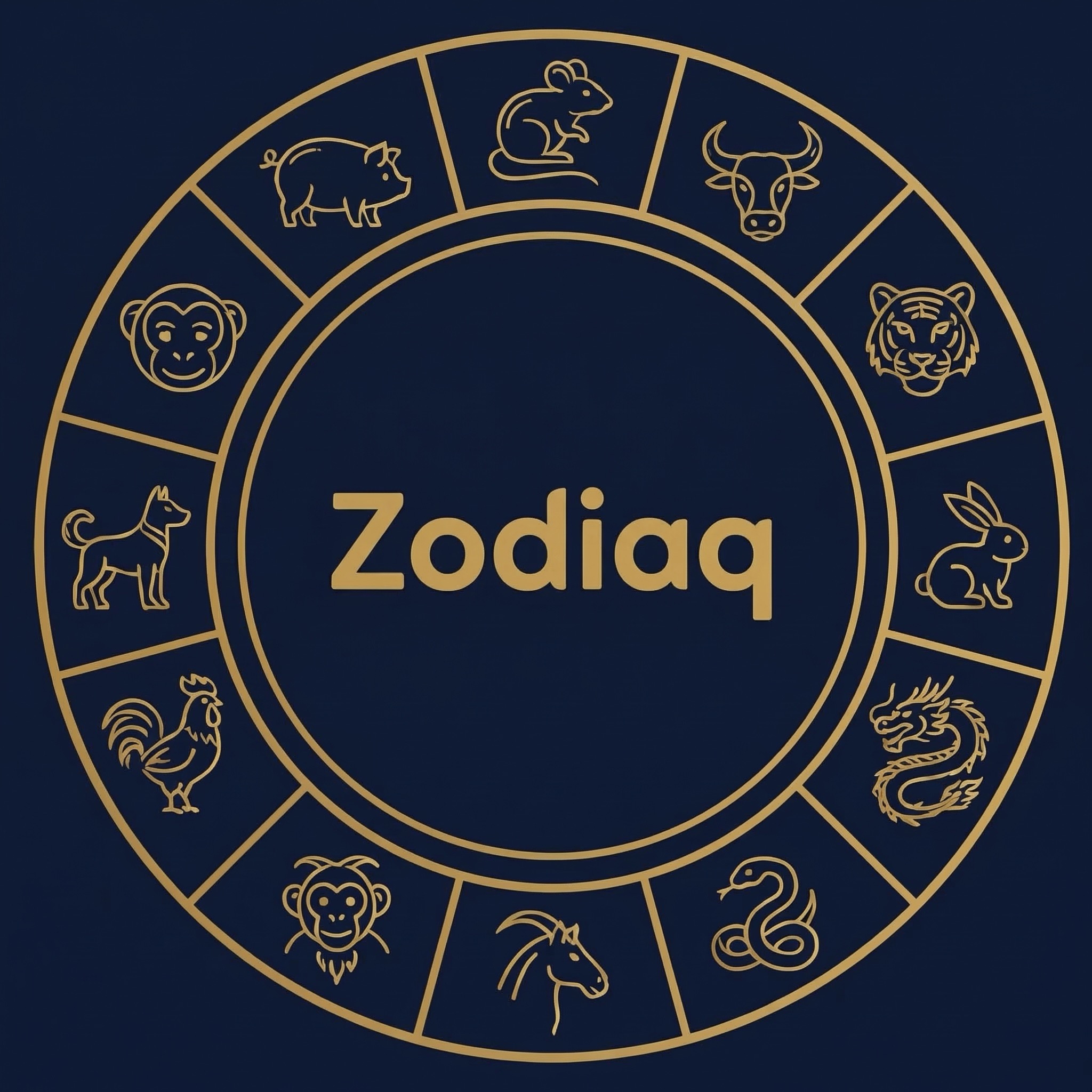
The twelve animals are a popular face for the twelve branches. Zi is the Rat, Chou the Ox, Yin the Tiger, Mao the Rabbit, Chen the Dragon, Si the Snake, Wu the Horse, Wei the Goat, Shen the Monkey, You the Rooster, Xu the Dog and Hai the Pig. When people say a year is the Year of the Horse, they mean its branch is Wu.
The best known story of the order is the Great Race. In one common version, the Jade Emperor invites the animals to a race across a river. The clever Rat rides on the Ox's back and leaps ahead at the finish, which is why the Rat comes first. It is a folk legend, told in many versions, and it explains the order rather than creating it.
The same cycle, different animals
The calendar spread across East and Southeast Asia, and some places chose different animals. In Vietnam the fourth branch is the Cat rather than the Rabbit, and the Ox is usually the water buffalo. In Japan the twelfth animal is the wild boar rather than the domestic pig. The character for the eighth branch is translated as Goat, Sheep or Ram depending on who is translating.
These differences change the pictures, not the structure. The branches, their order and the sixty-year cycle stay the same everywhere the system is used.
Key terms
- Lunisolar calendar
- A calendar whose months follow the Moon while extra months keep the year in line with the Sun and the seasons.
- Heavenly stems
- A set of ten signs, Jia to Gui, used with the branches to name units of time.
- Earthly branches
- A set of twelve signs, Zi to Hai, each linked to one of the twelve animals.
- Sexagenary cycle
- The repeating cycle of sixty stem and branch pairs, also called the ganzhi or jiazi cycle.
- Solar terms
- Twenty-four points in the solar year, about fifteen days apart, that mark the seasons.
Worked example
Counting to Maya's and Jun's birth years
A new sixty-year cycle began in 1984 with Jia Zi, the first pair. To find a later year, count how many steps it lies past 1984 and move both lists forward by that number.
Our teaching sample Maya was born in 1992, eight steps past 1984. Eight steps along the stems gives Ren, and eight steps along the branches gives Shen, the Monkey. The Zodiaq engine agrees: her year pillar is Ren Shen.
Our second teaching sample, Jun, was born in 1986, two steps past 1984. Two steps gives the stem Bing and the branch Yin, the Tiger. The engine gives his year pillar as Bing Yin. The next Jia Zi year will be 2044.
Notice that the branches return every twelve years, so 2004 and 2016 were also Monkey years, but the stem only lines up with the same branch again after sixty years.
History and traditionFrom oracle bones to a year count
The stems and branches appear on Shang dynasty oracle bones from around 1200 BCE, where diviners used them to date their questions to the ancestors. Their earliest known use was for days, not years.
Animal lists linked to the branches survive from the late Warring States and Qin periods, written on bamboo slips, and some of their animals differ from the modern set. By the first century CE, the Han writer Wang Chong could refer to the branch animals as familiar, and the list we know today settled over the following centuries.
Try it: Put the animals in order
Arrange the twelve animals in their traditional order, starting with the Rat and ending with the Pig.
Tap the items in order. Tap a placed item to remove it.
Your order
Still to place
Check your understanding
Question 1 of 5
Think about it
The same twelve branches carry a Cat in Vietnam and a Rabbit in China. What does that tell you about how symbols travel between cultures?